Monday, July 1, 2019

Recipe Notes: Oregon Blackberry Pie

23 June 2019

Recipe from Cook's Country, August 2016


When it comes to making pies, my confidence level is low. As a result I don't make as many pies as I otherwise would, and that is a shame because I like to eat pie. My lack of confidence relates to my ability to handle the pastry crust. From rolling out the dough (it never looks like a circle when I'm done with it) to putting it into the pie pan, trimming it, and crimping it ... I'm just never happy with the result. I know that all I need is practice. A perfect opportunity presented itself a few weeks ago as we visited Gizdich Ranch to pick ollalieberries. Most of them were made into jam but we set aside enough to make a pie, too. I used a recipe that calls for marionberries, but ollalies are similar so it should work fine.


The recipe uses an all-butter crust. Some sour cream was added to provide a little tang and to make the dough easier to roll out. The half pound of butter was cut into little, ¼-inch pieces. These were combined with the dry ingredients (flour, salt, sugar) with ten pulses in a food processor, about 10 pulses. Ice water was added and pulsed to form a dough that held together nicely. It was shaped into a disk, wrapped in plastic, and chilled for 80 minutes in the refrigerator. It was then divided into two equal portions. One was rolled into a disk and chilled. The other was rolled into a disk, cut into 1" strips, and chilled. To prepare the filling, 4 cups of berries (22 ounces) was gently coated with a mixture of sugar, cornstarch, and salt. These were then gently stirred with some lemon juice. The chilled dough was placed in a pie plate, the filling was added and dotted with butter. The strips were used to make a simple lattice which was not woven but looks almost as good. The edges were trimmed and crumpled and the pie was brushed with an egg wash. The pie was baked for 50 minutes in a 400° oven. Total time, excluding the four-hour cool down, was three hours, half of which was hands off.


This pie was great! Not only did it taste good but it looked good, too, providing me a much needed confidence boost in my pie-making skills. The filling was tart, but not too tart, with just the right amount of sweetness. It held together after cutting, no juice escaping into the bottom of the pie plate. The dough was easy to work with but ten pulses in the food processor were too many for the small pieces of butter: the crust was not real flaky, it was more like a short-crust pastry and it tasted great. It was a warm day when I made the pie so the dough was starting to get soft when I was crimping so it lost some definition, but I was still very happy with the result. I look forward to having this again when fresh-berry season comes around again.


Thursday, June 27, 2019

Recipe Notes: Braised Chicken with Mustard and Herbs

17 June 2019

Recipe from Cook's Illustrated, March 2019


I'm almost always up for a new simple method for preparing a staple like chicken like this recipe from a recent Cook's Illustrated. Braising is not a method that I usually think of for chicken, but it is simple and usually produces a delicious sauce to go with the meat. This recipe provides details for cooking different parts of the chicken so they are all done at the same time without overcooking any. We'll see how this works out.


I purchased chicken parts approximating the quantities specified in the recipe. I had one split bone-in breast weighing 1.4 pounds (it was huge but smaller than other breasts I had to pick from) and three whole chicken legs weighing 1.754 pounds. Thighs were separated from drumsticks,  the breast cut in half crosswise, and excess fat and skin removed. The breast was cut to produce pieces of approximately equal weight: a thin, tapered end and a broad end. The chicken pieces were brined for 30 minutes then removed from the water and patted dry with paper towels. All but the tapered breast piece were browned in vegetable oil in a Dutch oven, then removed to a plate. Diced onion was then cooked in the Dutch oven until softened and minced fresh thyme, garlic, and pepper were added and cooked until fragrant. Some flour was added and cooked for about one minute. White wine and water were added and the brown bits were scraped up. Thighs and drumsticks were added to the Dutch oven, covered, and cooked on the stovetop for 8 minutes. Then the broad breast piece was added and cooked. Finally, the tapered end of the breast was added and the covered pot was transferred to a 300° oven and cooked for about 8 minutes when the broad breast piece reached a temperature of about 160°. The chicken was removed, even though the tapered end of the breast was not done. Minced fresh parsley, whole-grain mustard, and lemon juice were added to the sauce and which was simmered for a few minutes. Total time was an hour and 50 minutes.


The chicken (we had dark meat) was very good, juicy and tender. The sauce, though, was too thin but it tasted very good. It complemented the chicken well and was neither spicy nor overpowering. For leftovers the sauce was reduced to thicken and it was even better than when it was fresh. The leftover chicken pieces were placed in a covered skilled over medium-low heat; by the time the sides were ready, so was the chicken. The dark meat continued to be good as a leftover, however the white meat was dry. I can see us having this again. I would stick with legs and forgo the breast (we prefer dark meat anyway) and I would be interested in trying some of the other sauces that were published with the recipe.


Wednesday, June 12, 2019

Recipe Notes: Everyday French Toast

6 June 2019

Recipe from Cook's Illustrated, March 2019


I have written several blog posts about French toast, trying different recipes, and I have written about its connection to my dad. I haven't made French toast in a while, but this new recipe inspired me to make some this week. The cooking method is special, this recipe allows you to cook eight slices at a time. Even when cooking dinner for two this is very attractive. But does it work and how does it taste?


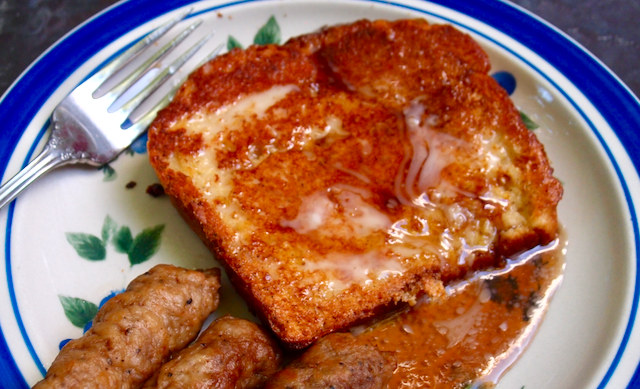
The "trick" used in this recipe is to cook the French toast in the oven rather than on a griddle or skillet. A rimmed baking sheet was sprayed with cooking spray and the oven heated to 425° with a rack in the lowest position. Another rack was placed 6½ inches from the broiler element. (The recipe said it should be 5 to 6 inches but my choices were 4½ and 6½.)The custard mixture was prepared by whisking together eggs, vanilla, brown sugar, cinnamon, and salt. Melted butter was added while whisking and finally milk (2% as that is what we usually have on hand). The egg mixture was poured into the rimmed baking sheet. Eight slices of white sandwich bread were placed on the pan and then quickly flipped. I used homemade Japanese Milk Bread. My bread slices were smaller than the store-bought slices used in the Test Kitchen and they did not soak up all of the egg mixture. I poured off the excess to make clean up easier. The bread was baked on the lower rack for about 12 minutes until the bottoms were golden brown. The rimmed baking sheet was then moved to the upper rack and the broiler was turned on. After about 2½ minutes the top side was done. Total time to prepare eight slices of French toast: 40 minutes.


Yes, it works, and it tastes great! This is a wonderful new way to make French toast. All eight slices were done at once. No cooking a few at a time then keeping them warm in the oven until all are done. No getting up from the table to return to the kitchen to tend the next batch. The toast was crispy with a nice, creamy, vanilla interior. It kept well in the refrigerator and was good after re-heating in the toaster. This is the way to go when making French toast.

Wednesday, May 29, 2019

Recipe Notes: Cod Baked in Foil with Leeks and Carrots

26 May 2019

Recipe from America's Test Kitchen


In Boy Scouts we called them "hobo dinners" and they were cooked on a campfire. In restaurants you can get meals, often fish, cooked en Papillote. Fish, vegetables, and seasoning are closed in a pouch of foil or paper and baked. In the closed environment the food steams efficiently, the flavors meld, and nothing is lost. The ATK TV show featured such a meal created using cod. In my quest to learn more fish recipes, I tried it.


The published recipe was for four people. Since fish is not usually good as a leftover, I made half the recipe. Prep consisted of several steps. A compound butter was made with butter, lemon zest, garlic, thyme, salt, and pepper. A garnish was made with parsley, lemon zest, and garlic. The skinless cod fillet was cut into two pieces, each about 6 ounces, patted dry, and seasoned with salt and pepper. A carrot and leek were cut into 2-inch matchsticks, seasoned with salt and pepper, and mounded on a sheet of foil. A tablespoon of white wine was added to each mound (in place of the vermouth in the recipe). The fish was put on top of the vegetables and smeared with the seasoned butter. A second sheet of foil was placed on top and the two sheets crimped together. The two packets were placed on a rimmed baking sheet and placed into the oven at 450° for 15 minutes. After that time they were removed from the oven, the packets opened, and the fish, vegetables, and accumulated juices transferred to plates. They were garnished with the parsley mixture and served. The total time was 55 minutes, the last 15 of which was hands off.


The success of this recipe depends on the preparation of the fish and vegetables since the cooking is blind with no opportunity to check for doneness. The fish, in particular, needs to be the right thickness. The thickest fillets I found might have been a little thinner than the specified 1 inch, thus they were just a tad overdone. Likewise, I may have cut the vegetables too small as they were also a tad overdone. That being said, this was a good dish and worth doing again. The fish was flaky and juicy, for the most part. It could have used some more seasoning, perhaps putting salt and pepper on both sides rather than just one would fix that. Or maybe it was because it is cod which does not have a strong flavor.  I thought there was too much leek and not enough carrot.